

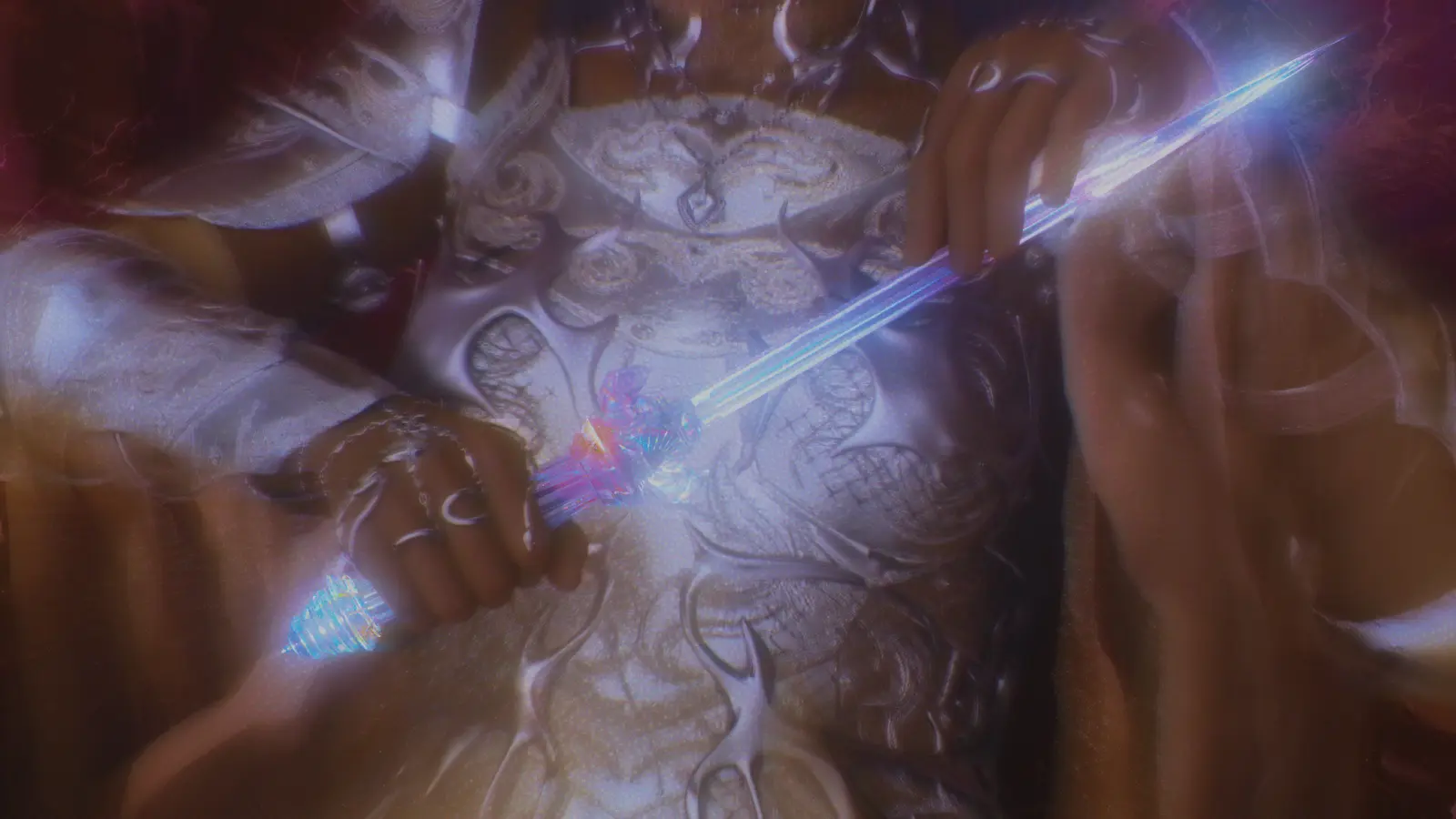
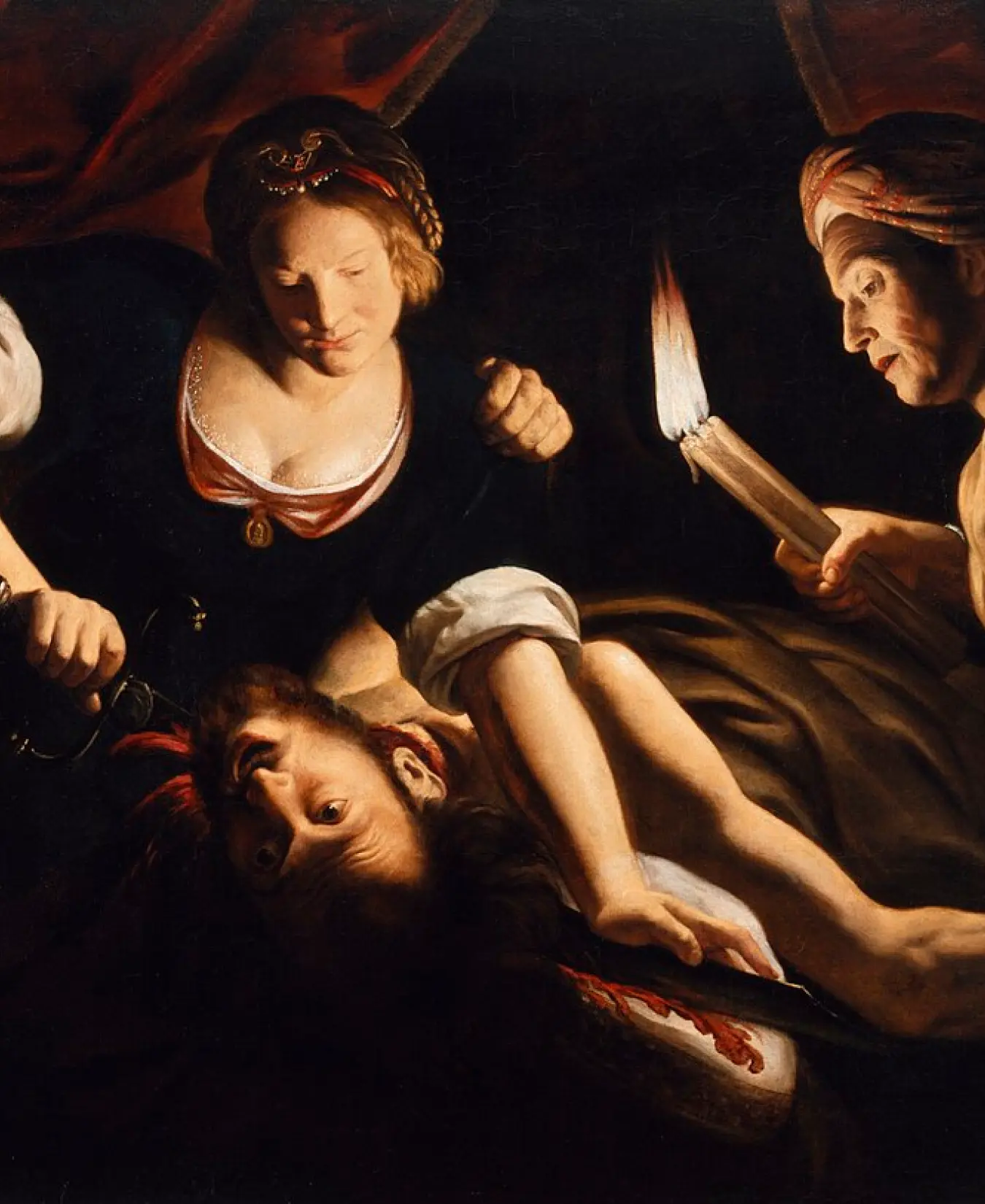
Standing next to Trophime Bigot's "Judith Decapitating Holofernes" in the Walters Art Museum, I smile for a photo as one would with a beloved character at Disney World. It is a work I've only ever seen on a small screen. Here, it hangs on its own wall. Bigot's chiaroscuro pulls the eye to Judith's face, but what has compelled me to seek out this piece, what has made the work so famous, is in her hand: the sword, driven through the neck of a man above her gender and rank.
"This isn't even the best one," I tell my husband. Artemisia Gentileschi's is much more gruesome, complete with a burst of blood staining Judith’s bodice — a detail perhaps only a female painter would offer. It’s Gentileschi's that has been reposted, memed, printed on protest signs and shared among my group chats in recent years. Such juxtaposition of femininity, aggression, and revenge has placed Judith among the likes of the Valkyries and Joan of Arc as history’s violators of the natural order.
As it turns out, we’ll be seeing Joan again very soon. Director Baz Luhrmann has started production on the first major English-language adaptation about her life in a quarter of a century. This comes as no surprise to those who, like me, have observed sword-wielding women re-emerging in modern culture with striking frequency — showing up on red carpets, in bestselling books, and throughout our algorithms. Looking at the centuries-old story before me, I begin to understand why.
I can’t get too close to “Judith Decapitating Holofernes” though. They've placed a large wooden table directly below it. It’s as if the museum wanted to keep women from reaching out, from taking the weapon for themselves. But they already have.
“This is who I truly am,” Meg Murayama captions an Instagram post to her almost 400,000 followers. She’s head-to-toe in fantasy attire, holding a massive sword. From Pinterest to Tiktok, Meg has amassed a huge following, not from costumery or cosplay, but from years documenting her trending fashion and beauty expertise.
Now, she’s found a new following from posting about her interest in swords and fantasy books; the sword rising in popularity throughout her friends and fellow influencers. She recently collaborated with jewelry brand Ask & Embla for a collection that includes dangling sword earrings and custom-embossed packaging with a sword on the front. When I ask Murayama if she sees the sword as political, she brings up her Hinge profile. A portrait, like the one previously described, is proudly displayed alongside mention of her love of medieval literature. “I get a lot of weird and misogynistic comments from men on both the photo and prompt,” she says.
I have to wonder what the reaction would be if Murayama were instead holding a gun. Somehow, I don't think she’d be seen as nearly as much of a threat. A gun is contemporary. It belongs to now, to the news, to real and recent violence. According to a 2024 article, women of all political leanings are leading a surge in gun ownership “for protection.” But a sword isn't a threat in any literal sense, so why would it possibly provoke? Murayama knows, despite never endeavoring to send a message.
“Obviously it's a prop/stylistic accessory … but to me and to medieval/fantasy girls everywhere, I know it represents way more than that. A display of interests, a call to power, a reclamation of agency … so yes, when held by a woman, the sword is a statement, even if it’s not intended to be,” she says. Ultimately, swords don’t belong in this century, just as they’ve never “belonged” in a woman’s hands — that combination creates a target. Even if she's not looking to take heads, the sword-wielding woman will always find someone who wants to fight.
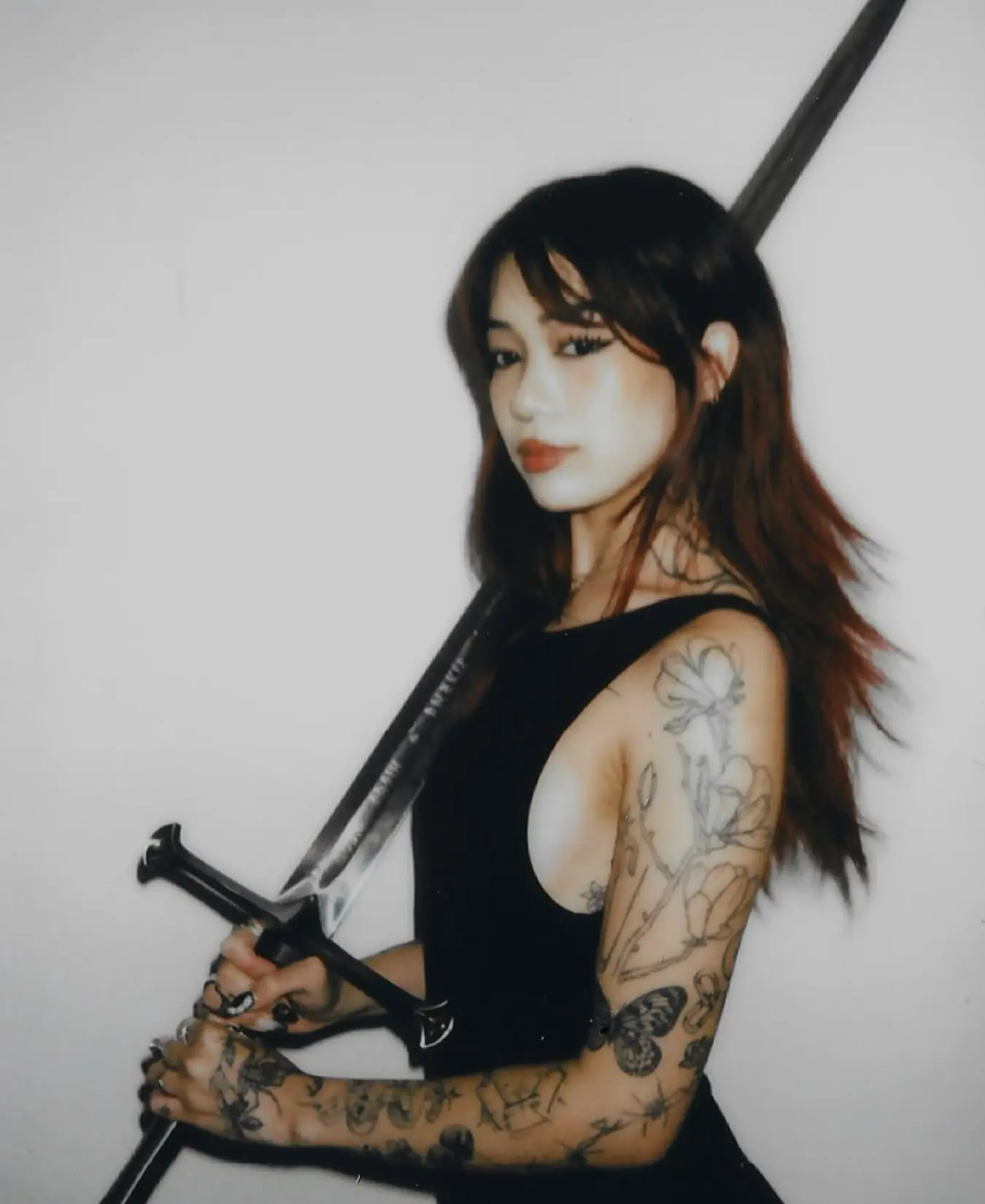
Meg Murayama via Instagram
When I picture that fight, I think of Chappell Roan — one of Murayama’s favorite references — who’s widely credited for kickstarting sartorial sword-bearing. For her debut at the MTV awards, Roan earned a place on everyone’s moodboard by complementing her 17th century robe with a sword. In Interview Magazine, Roan’s stylist Genesis Webb revealed that integrating the sword was about “showing her femininity, but also the power that she holds … the knight gives her the sword, and she gives it back.” It was a planned performance, complete with a hired knight, to be carried out on the carpet. But just after Roan passed off the sword, her icon of “power,” a male photographer yelled for her to “shut the f*** up,” leading to what is now a viral encounter of Roan yelling the same back to him.
People did not like Roan expressing her anger. I’ve watched this single break from “decorum" follow her for several years. In the book Good and Mad: The Revolutionary Power of Women’s Anger, author Rebecca Traister writes, “The act of a woman opening her mouth with volume and assured force, often in complaint, is coded in our minds as ugly” — which helps explain why most historical representations of the armored woman (by men) are close-mouthed and calm. Roan’s experience on the red carpet is not unlike most historical depictions of the sword-wielding woman. Curator and feminist activist Claire Mead goes on to confirm in her essay on the history of women and swords in art: “Asserting femininity while wielding a sword is celebrated as long as this femininity is not seen as disruptive, dangerous, or transgressive.”
Thankfully, Roan had a much larger greatsword in hand when she performed the queer F-You anthem “Good Luck Babe.” Despite media outlets giving her the nickname “Roan of Arc,” her quest for agency seems long from finished. This year, a man falsely accused her of yelling at a child, causing a new wave of public hatred towards her, only for him to retract the story later. Unlike Judith and Joan, the battle for women today is not always physical, the violence, not always direct. Maybe it's the rage, simmering underneath, that remains the same.
After Roan's awards night, reporting about fashion's embrace of swords, armor, and chainmail exploded, though none of the shallow "Medievalcore" coverage named female rage directly. Most of what’s still being published today chalks up the woman-with-weapon as merely a result of the 20-year trend cycle, as if the sword sits on the same shelf as skinny jeans, collecting dust until it’s chosen again.
For a recent piece in W Magazine, titled “In Uncertain Times, Fashion Reaches for Its Armor,” Avery Trufelman cites a “longing for a simpler era” as the reason for fashion’s recent “obsession with the Middle Ages.” A simpler era? That's an interesting choice of words to refer to a time that was devoid of safety, rights, and respect for women. Maybe that is why the sword feels so familiar now.
Apparently we live in a “post #MeToo” world, an oft-repeated phrase that suggests the brief period of accountability is over. Still, the horrors persist. Women are being assaulted just as they have since the dark ages. This year, a global “online rape academy” was exposed, where men traded tips on how to drug and rape their wives. In the U.S., there are 33 states that still allow child marriage, and three states have no age minimum.
Reproductive rights have their own chapter in the long book of threats to women’s health and autonomy. The Arizona Supreme Court attempted to resurrect a near-total abortion ban from 1864, a law older than women's right to vote, still being championed today. Women have been forced underground, to covert networks, in order to receive lifesaving care and avoid persecution. To resist what feels like ancient levels of oppression, reaching for ancient tools feels fitting. The sword recurring this insistently is worth examining, not only because of how it looks, but what it's diagnosing. I’d call it a symptom of collective anger. The cure? Ask Judith.
Meanwhile, designer Robert Wun sent a sword chest-piece down the haute couture runway as a reminder of the perseverance of craft. Ffern’s latest campaign puts women at the Round Table, featuring a female “Green Knight” who champions the earth, bringing summer to women in need of strength. But with so many endless lacerations to the female psyche, from the Oval Office to the manosphere, I sometimes wonder whether these grand depictions of female warriors demand too much and do too little. Around the same time that fashion brand Amor Mía released a weapon-filled photoshoot, a “pastor” publicly declared “Women are the kind of people that people come out of.”
Sometimes I can barely stand, let alone hold a sword.
Just when I thought I’d seen every battle-ready, renaissance-ian remix of the armed woman, I found Bella Newman’s photo series “gn.” Shot from above, as if watched over by the gods, women lie on quilted mattresses and patterned bedspreads with various daggers, battle axes, swords, and spears. The instant kinship was uncanny. They could be my mother, sister, friends … the things we carry with us every day. The beds were not unlike the ones in the suburban home I grew up in. One of the models looks so sharply through the camera, a sword ready at her hip, I feel the urge to point to myself. “Me?” Yes, you, she says.
In Women Who Run With the Wolves, Clarissa Pinkola Estés, PhD, illuminates the forms the “Wild Woman” — she, who is deeply connected with the feminine psyche — might take to activate our attention. It’s “a relationship which may have become ghostly from neglect, buried by over-domestication, outlawed by the surrounding culture, no longer understood anymore. We may have forgotten her names, we may not answer when she calls ours, but in our bones we know her.” After so much uncertainty, I have finally found her in “gn.”
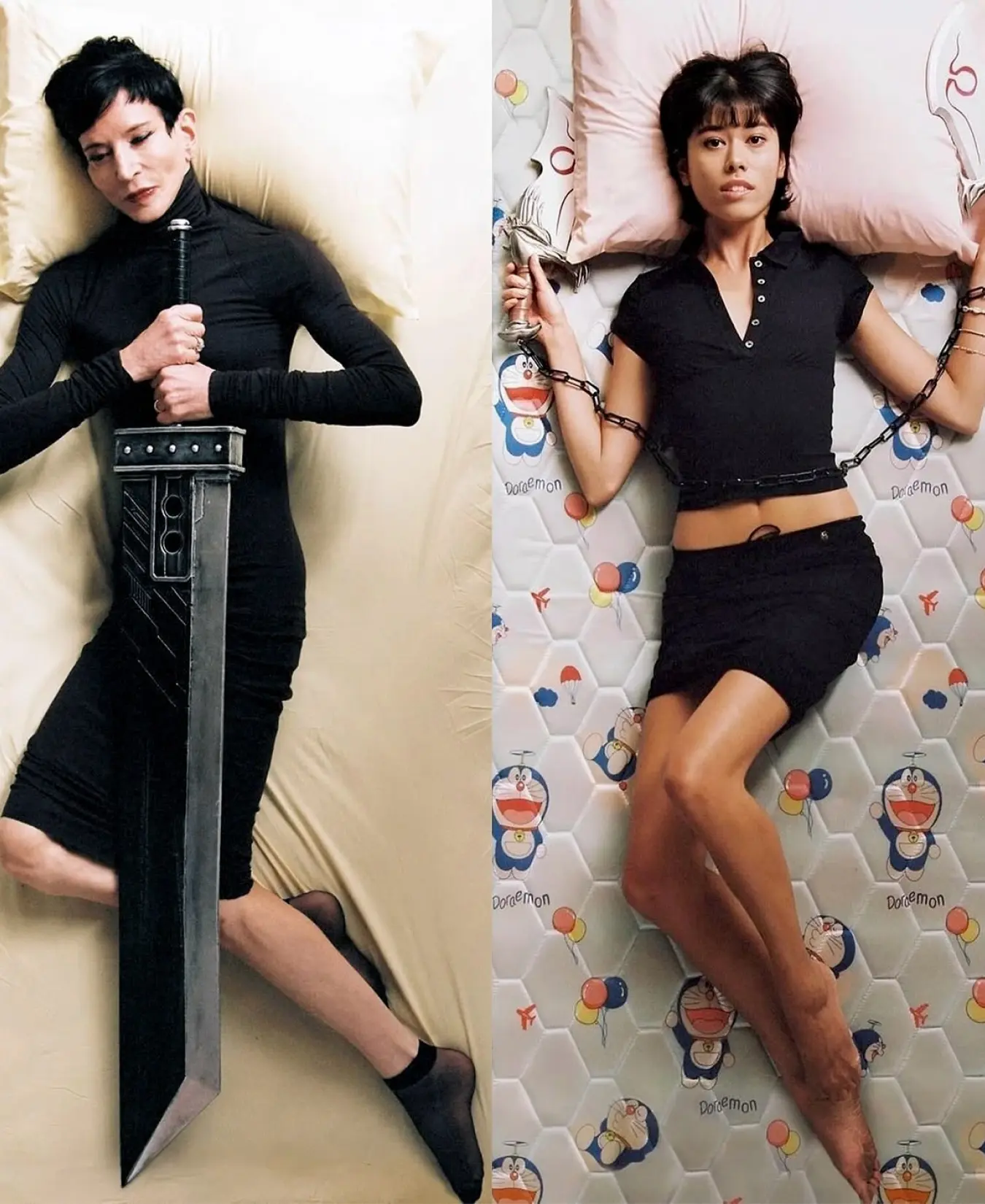
gn by Bella Newman
From the plump pillows to pairs of cotton panties, Newman’s weapons are enveloped in softness. Femininity, as seen in the pastels, silks, and pinks, is layered so artfully their construction becomes concrete, their power undeniable. It is she who is protecting the sword and not the other way around. But my favorite quality of “gn” is its lack of an identifiable period. “Held out as markers along the path,” as Estés says, these women and their weapons exist backward and forward in time, just as the female warrior has and always will. The horrors persist, but so do we.
“Gn” also reminds that sometimes resistance means finding places to retreat. Take the Romantasy genre, where readers escape into stories of female protagonists wielding weapons against dark forces. Since 2022, (the same year Roe v. Wade was overturned) it has skyrocketed in popularity and spawned a wave of new television adaptations currently in production. A dress on the runway captures just one frame of the sword; the weapon-wielding women of Romantasy live out the whole story.
Despite this, BookTokers (and myself after a few drinks) have had to defend the genre’s merit against those who deem it low-brow. Christina Clark-Brown explains to The Guardian, “There is no damsel who needs saving but rather women are allowed to be powerful.” Author Georgia Summers says, “We’re seeing fantasy normalise queer romance, normalise having people of colour … have it not be the traditional white male medieval village scenario.” A stark difference to our reality. But even in our moments of refuge and forms of entertainment must we always have to overcome? Can a woman wield swords without being oppressed?
Stuntwoman Ayesha Hussain and film director Jade Ang Jackman are answering those questions with their careers. Their collective, Babes with Blades, is carving out more space for women, especially women of color, in the action genre — in front of the camera and behind it. Even their name reclaims a Western stereotype: female characters with no lines and no backstory, just a sword and sex appeal.
Although Jackman admits her interest in directing combat began as “a way for women to take fictitious revenge and rage against” sexual violence, oppression, racial aggression and more, the pair have focused on expanding the types of stories surrounding women and weaponry. In their short film Split, women battle over a bar tab. It’s small stakes, but John Wick fought for four movies in the name of his murdered puppy. “... finding ways to continue championing diversity in the presentation of female action-heavy characters with storylines that don’t always stem from sexual violence or murdered parents is key,” Hussain tells Polyester Mag. Even more essential is the collective’s role in ensuring the woman with weapon doesn’t fade into myth or legend, but stays alive (and dangerous).
While Babes with Blades puts the sword in “new” hands for the screen, some women want the blade to be real — and hit really hard. Such women are practicing Buhurt, a rising sport where participants put on 80+ pounds of medieval armor and fight one another like it’s the 14th century. The movements might be ancient, but Buhurt is alive in cities across the country.
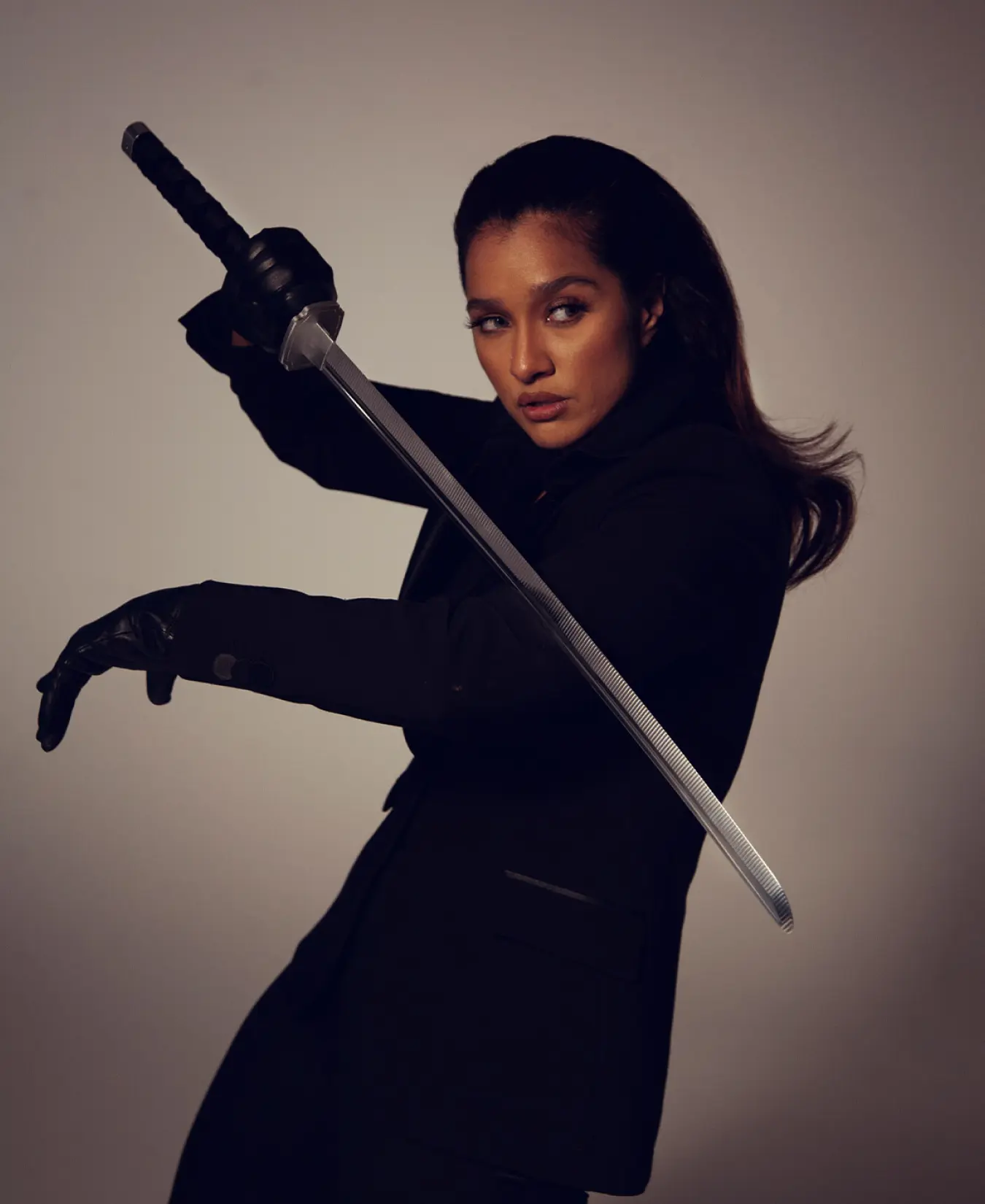
Ayesha Hussain of Babes with Blades
Why would anyone do this? I ask myself as I wince through combat videos. I tracked down 48-year-old Belinda Q., who fights in an all-female league in Arizona. “I would say that it has helped my overall confidence. I know I can do hard things,” she told me over email. One of Buhurt’s biggest names is Shoshana Shellans, the subject of a 2021 documentary following women in the sport. Steel Song focuses on Shellans, who has the magnetism of Arwen and the prowess of Aragorn. In the documentary, she speaks of duelling as a “purpose” rather than a form of exercise: “I keep fighting because of what I can continually prove to myself about myself.” Another woman, Bridgette, who struggles with Autism and physical tremors, suits up and says, “I’m worth more than what other people seem to look at me and think.”
I can’t quite comprehend the voices coming through the helmet grills. Women laughing about the metal helmets creating knots in their hair, asking one another for ponytail holders and combat tips. Every time I watch them embrace after a match, heavy arms lifting to hold one another, I get a morning-star-sized lump in my throat. Their sheer existence on this timeline feels like a rewrite of history itself. But on Shellans’ Instagram I’m brought back to the present. She posted a video of infamous woman-abuser Andrew Tate inferring that women are lazy, but finished it off with a video of herself giggling while wearing her many gold competition medals. Whether the fight is internal or external, Buhurt’s female warriors are coming out swinging. But for those who prefer a softer style, there is now improbably, sword yoga.

WeaponUp, sword yoga
In the summer of 2022, I found myself searching for my own physical outlet. The muted pastel of pilates did not fit, nor the colorful Zumba days of old. I discovered Wushu, a Chinese-based form of Kung Fu that incorporates a sword in its practice. I took a free class. I wish I could say it was an instant connection, that the sword was put in my hands and the world moved, but I felt like a complete fraud. After an hour of weapon-less rudimentary training, the only barrier I was ready to break through was the exit. But then I saw, for the first time, a young girl pick up her own sword.
When I tell Iris, now 12, the subject of my essay, her eyes turn to orbs. After four years I’ve risen to her rank, but she's set to advance again soon, and rightfully so. Iris has grown up during a period where swords have become a common language through which women (including her own mother, the school’s instructor) can communicate. They even show up in the hands of her favorite group, Katseye. Seeing her wield this power from such a young age led me to continue to gain proficiency in bow staff, straightsword, and spear. Iris and I click the hilts of our swords, with their different-colored accessorized tassels, before training together — striking and blocking invisible forces in performance. For her, I hope they do stay invisible.

Me, practicing in the park
For me, it’s become clear that “taking up arms” is not always literal, but it would be a mistake to dismiss it for fantasy. It is perhaps a means of mental and emotional preparation, a way for women to cast our soft hearts onto something cold, hard, and unbreakable. A vessel, like a genie in a lamp, for imbuing our anger so that it can be lifted from our shoulders. A projection of imposing invulnerability so that others may not assume what we’re capable of by our outward appearance.
Reducing all of this to a “trend”? That’s like calling a tapestry a carpet. When they dig us up 4,000 years from now, I hope they’ll see the many ways our power, strength, and resistance has not lost its shape. Until then, I’ll continue to welcome the sword in any form it takes.
Phoebe Bridgers returned to music after a four-year hiatus with a new single, “Lost Boys.” In the accompanying video, she stands on top of a parked car in a billowing blue dress as armored soldiers fight on the ground beneath her. Later, she’s up again, on the backseat while the men drive. Bridgers matches Bigot's Judith; calm, determined, as if she already knows how this ends. Against the wind, she holds a shining sword over her head, looks directly into the camera and sings, “find me.” Bridgers may be the latest woman to reach for the sword, but if recent events have taught us anything about the armed woman, it’s that she will, in fact, find you.
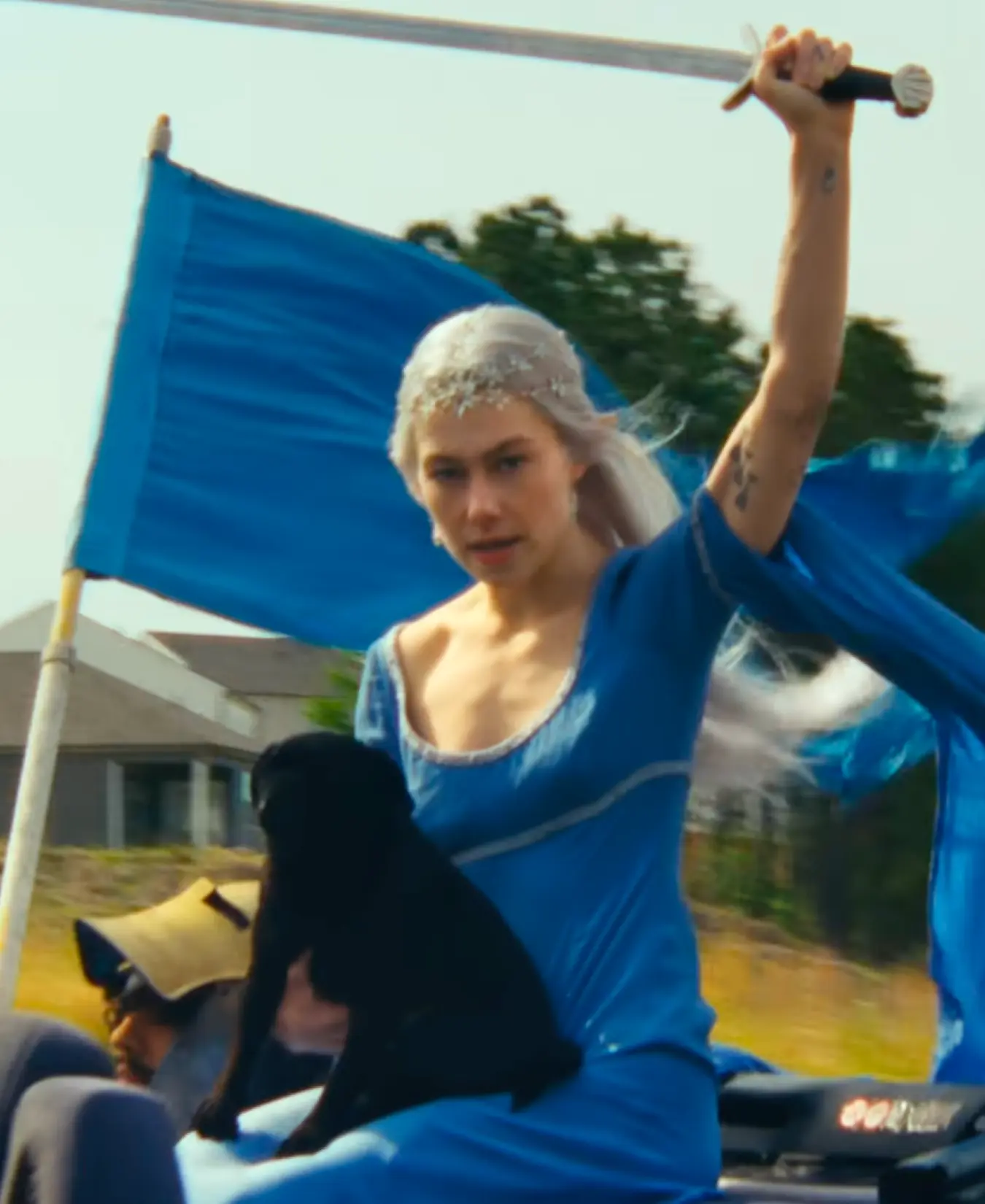
Phoebe Bridgers in ‘Lost Boys’


