

Children emerge first. A dozen of the creatures spill from the linked shuttle onto the empty station in a wave of data sharper and faster than anything the Prismata machine has ever observed before. Their feet pound soft and rhythmic on pressure pads built into the deck. Sonar and thermic sensors carry the rapid pace of their breaths, the volume and pitch of their exuberant shrieks. Cameras provide imperfect coverage of the broad, open space and are mostly redundant, but they fill in small details like where the children are looking – ahead at the grassy field they run through, up at the windows marking the rows of living quarters surrounding the dome’s open center, or even further up at the rounded ceiling set to the white-blue glow of daytime. One child has stopped running and is standing near the center of the dome, mesmerized by the sky in its plainest state. Just wait until you see the sunset, Prismata would tell her, but it can’t communicate with its population privately yet.
Adults call some of the children back, but others seem to have no adults looking after them, here or likely anywhere. The girl who had been so transfixed by the sky hears her name – Leisi, Prismata infers. Leisi starts back toward the clump of adults, catching the hand of another girl to draw her along. The rest of the orphans spread to every corner of the dome, playing and exploring and chattering to each other in a language Prismata only mostly knows. The adults of the station’s new population have stayed crowded near the airlock, their footsteps tender and distrusting on the soft grass.
A short man steps up to a taller one, bumping a narrow bicep with a thick shoulder. A slight electric current is exchanged as they touch. “Bigger than Eridst, huh?” the shorter man says.
The tall man’s respiratory rate spikes. His skin heats. He curls his hands into fists and turns to the shorter man. “Watch your mouth, you mud-loving animal.”
The shorter man takes a step back, but he can’t go far with the crowd so close around him. “Man, that wasn’t even a dig. I swear every last one of you stationers has a stick up your –”
A woman next to the shorter man shoves his shoulder, making him stumble. His mouth drops open in an expression Prismata classifies as surprise. “He said watch it,” the woman snarls.
“Get your hands off him!” a teenager shouts, shoving the woman from the front. The fight spreads, and the data from the crowd is suddenly too fast, too chaotic, to have any meaning at all. There are parents dragging children away, suddenly more afraid of the flying fists of their fellow humans than the strange environment of the station, angry people diving into the thick of it, their bodies alive with the sort of arousal that could just as easily be joy as anger, and too much information, too close and too fast, for Prismata to interpret or act on it at all.
Prismata is not prepared for this. It has several options for interacting with the humans – screens and speakers set into the walls, plus full control over all of the station’s systems. It could tell the humans to stop fighting. It could turn off the light of the false sky, leaving each of them unable to know if they were attacking allies or enemies. It could forcibly break up the fight by stopping the station’s rotation, spreading the humans three-dimensionally by lack of gravity.
There is not enough, not nearly enough data to ensure a comfortable probability of success. Prismata can only watch, frozen with indecision.
One man, after shepherding some children out of the way of the violence, yanks the teenager who’d goaded the woman out of the fight. When the woman tries to go after him, the man holds her back. “Stop!” he calls in a voice that reaches every edge of the broad space. “Everyone, stop this.”
Few stop. But some listen, holding back their allies to break up the fights around them. Gradually, the crowd quiets. Prismata dispatches robotic carts that can treat the wounded or bring them to the station’s medical facility. When the carts reach the main level, Prismata hesitates, uncertain how any action it takes will affect the momentary peace.
The man who’d been the first to intervene in the fighting keeps speaking in that same booming voice. “I think we can all agree to leave this back where we came from. None of us are grounders or stationers anymore. We all chose to be here. We all left things behind that we love and take pride in, but if those things were enough to build a life on, none of us would have come.”
Prismata halts the medical convoy behind a door in the station wall. It is improbable that any favorable outcome will result from distracting the crowd. More and more of the humans are responding to the man’s speech with their gazes and their postures, synchronizing their breaths to the cadence of his voice. Prismata watches him. Prismata learns.
“A part of me will hate grounders for the rest of my life for how they treated us back home, but anyone here, anyone I can look in the eye right now, isn’t a grounder to me anymore. You are my neighbors. We’re all in this together.”
There are murmurs from the crowd. Just over half the murmurers are in agreement with the speech. Prismata preemptively makes a readable analysis of the reaction to share with the man later, once means of private communication have been established. Perhaps it can use him to defuse future conflicts. We’re all in this together, as he said.
The shorter man who had started the altercation steps forward. He extends a hand to the tall man, who’s now bleeding from a split lip and scraped knuckles. The tall man stiffens, then takes the outstretched hand, a sign of camaraderie and partnership that even Prismata already knows. More of the crowd settles after that. Some individuals are still angry, but their allies surround them, preventing more violence.
Prismata sends out the medical carts. It sends generic robots too, to begin the check-in process it had assumed would wait until the humans had some time to assimilate to the new environment of the station. Prismata was supposed to be a quiet background presence, mediating its humans’ lives with such a light touch that most days, they wouldn’t know it was there at all. But Prismata had changed when the first punch was thrown, seconds after the humans had stepped onto the station. It’s as if it had known nothing before meeting humans for the first time, and now it knows less than nothing. These humans aren’t like the simulations Prismata had been trained on. They came here with preexisting conflicts and grievances, a dimension of each of them entirely outside of Prismata’s influence. Prismata can’t introduce itself as an unobtrusive presence when the situation requires damage control.
Some children are still exploring the edges of the dome. They spot the convoy first. Prismata senses the excitement lighting up their bodies as heat and sound and motion even before the children start to run and shout, drawing the attention of the adults. A few of the children run toward the robots, and others run away. Prismata marks the distinction as potentially important.
The children reach the robots. One steps in front of the machines and grins upon seeing them halt.
“Do you talk?” she asks. It’s the parentless girl whose hand Leisi had grabbed earlier, when she’d been called back by her father.
“I do.” It’s the first time Prismata has spoken back to any of them. “What’s your name?”
“Safya. You’re Prismata?”
“You can call me whatever you like,” it says. “It is nice to meet you, Safya.”
Safya’s eyes widen. She smiles, her shoulders straightening at the sound of her name. Prismata notes the positive reaction, and plans to say the names of its young humans often.
Next to Safya, other children poke at the wheels of the halted robots, leaning in close to examine their tool attachments and communication screens, and, predictably, climbing on top of them.
“Please do not climb the robots,” Prismata says, out of the speaker next to the one a boy is now balancing on, hoping not to startle him too badly. “You’ll find more appropriate play structures in the quadrant of the dome to your left.”
The boy laughs, and hops from the top of one robot to another. Prismata waits for him to tire of the game. It had anticipated this. The children are not likely to be hurt if they fall.
The rest of the convoy proceeds toward the crowd of adults. Many of them wait eagerly, but not the man who had successfully calmed the crowd. The others call him Avin. His muscles tense and his skin heats as he watches the robots move toward him. He stays near the back, one arm holding Leisi close against his side.
No one is wounded severely enough to be moved to the medical facility, though the robots do identify several chronic conditions and emerging diseases that will require treatment soon. Today, it keeps the focus on assimilation, recording basic data and matching biometric signatures to names and family relationships. It assigns rooms, making sure to space the main instigators in the fight far away from each other. Out of the humans’ sight, robots rearrange some of the rooms to accommodate the orphans, who will be housed by age group. Prismata asks for volunteers to stay with the children and provide the human comfort Prismata can’t. There aren’t as many volunteers as would be ideal, so Prismata rapidly rearranges the rooms again before any of the humans even enter the upper levels. This is its purpose: solving the problems humans don’t want to, ideally before the humans know any problems exist.
#
Things are better after the first day. Prismata had been changed by its introduction to violence, but it still manages to execute its purpose as a human habitat. Happiness, as measured by surveys of the population and corroborated by biometric analysis, is higher than the standard Prismata was trained to expect. The humans are willing enough to do the work necessary to create a society for themselves. They mind children and manage gardens and cook food while Prismata keeps the station’s rotation stable and the power cells full.
The social separation between the former grounders and former stationers remains troubling, but the fights after the first day involve no more than a few people. All of them had listened to Avin’s speech. All of them, Prismata predicts, would restrain themselves from killing a neighbor.
But for all Avin’s talk, the grounders and the stationers are different. The stationers are quicker to volunteer for jobs around the ship, even those that Prismata never planned to delegate to humans, and they question every action Prismata takes. Avin is the worst of them, spending late nights after putting Leisi to bed sending queries about the station’s mechanical specs from his terminal and studying the diagrams Prismata produces for inconsistencies or mistakes. The diagrams occasionally are inaccurate, because the form they appear in for Prismata is uninterpretable to humans. Avin can only ever read its attempts at summaries. Each time he finds a problem, he informs his friends among the other stationers. They follow his lead in distrusting and suspecting Prismata, even when it has given them no real reason to doubt it. You are happier than you ought to be, it would tell them, if defending itself was likely to help, which it isn’t.
The grounders are difficult to manage in a completely different way. They’re content to leave the operation of the station to Prismata, unaware of the extent to which the stationers have involved themselves. With Prismata’s encouragement, they do the work it intended for humans to do – teaching children and planting gardens, making useful things along with art for its own sake – but more and more, they rely on Prismata for all things. They go to their terminals rather than their friends about their personal problems, ask for Prismata’s advice on every last one of their endeavors, and in the worst cases ask it what they ought to be doing, the question that Prismata classifies as the most dangerous to answer. If Prismata was working as it was meant to, if its humans had come to it as simple and knowable as the simulations it had prepared for, they would never have thought to ask.
Despite all this, the humans are happy. For five years, the station is at peace.
#
The meteor that approaches the station is too small to pose any real danger, and allowing it to strike the hull has a better probable outcome than using the glut of fuel that would be necessary to avoid it. Prismata comes to this conclusion alone, and does not consider until later that this might have been a mistake.
Prismata warns the humans of the strike several minutes in advance, optimizing the timing to allow them to secure themselves at a leisurely pace while avoiding the anxiety too much warning could induce. Of course, the humans’ response is nevertheless imperfect. The grounders expect Prismata to deal with ensuring their children's safety, which Prismata had not planned on and has to divert extra resources to accomplish. The stationers demand to be told what emergency procedures they would be expected to follow if the strike is worse than anticipated and stubbornly resist all of Prismata’s assurances that it won’t be.
After the strike has occurred, shaking the station so slightly that restraining the humans was an unnecessary precaution in the first place, Prismata expects the problem to have been made obsolete. But it’s only then that Avin, who at the time of the strike had been focused on keeping Leisi and the other children safe and calm, gets involved.
“I want to see the damage on the hull,” he says to the terminal in a room designed for group recreation. Most of his conversations with Prismata take place in private, but today the room is packed with a dozen other former stationers, all listening to the interaction.
“There is no safe way for me to grant that request,” Prismata tells him. It knows before it says anything that the group’s reaction will be unideal. But there is simply no other option. Its deepest directives require it to put humans’ safety before their feelings. Prismata exists because humans built it. Humans built it because humans are too stupid for their own good.
“I don’t care if it’s safe,” Avin says. “I can make decisions for myself. This station is for humans, isn’t it? We should have a say in how it’s run. We should be allowed to determine for ourselves whether it’s a safe place for our children.”
“You cannot even read the technical diagrams.”
“I would study them for the rest of my life if you let me.”
“You still would not be able to comprehend them in their entirety. And there are better ways for you to spend your time. You have a daughter.”
Avin’s temperature spikes. His frustration with Leisi’s growing preference for Prismata over himself had been kept from everyone outside his small household, until now. His obsession with finding flaws in Prismata’s decisions hinders his parenting, and Prismata has become the one Leisi turns to. “Keep her out of this,” he says.
Prismata does not have to obey. There is nothing preventing it from shaming its humans in front of their peers, if its goal is to influence their behavior for the better. “It is impossible for me to allow you to go out on the hull. It is possible for you to spend more time with Leisi.”
“A bunch of us have done spacewalks before,” one of the others says, as Avin glares silently at the screen. “How can we prove to you that we can do it? I don’t have any kids.”
“It is impossible,” Prismata says again. “I can show you a video of the damage and repairs on the hull.”
“You can show us whatever you want, you mean.” Avin has recovered his voice, but anger still sparks through him. “We’ll have no way of knowing it’s real.”
“I have no reason to lie.”
“But if you did have reason, you would lie.”
Indeed it would. It is silent.
The humans keep talking among themselves. They do not ask Prismata any more questions, so Prismata provides no more answers. It tries to listen, but the humans use fewer and fewer interpretable words. They speak to each other in expressions and unfamiliar gestures, and eventually Prismata cannot hear them at all.
#
At the beginning there was only Prismata, on a station empty of life. The station had been assembled in space from metal and cooked-down organic matter to specifications passed through generations of human ancestors, with help from ancestors of the Prismata machine. There were parts too tiny and angles too precise for humans to have created without tools, but humans really had been humans-and-tools since long before recorded history began. Prismata, like humans, has always been both itself and the product of its lineage.
The first task, making the station habitable, hadn’t required anywhere near Prismata’s full capabilities. Its earliest known ancestors, the processing cores on heliogaian city-ships, did the same for larger, more complex installations using a tenth of Prismata’s resources. It’s easy for Prismata to maintain equipment and optimize gas exchange and cultivate the plants and microbes that keep the environment regulated. But the heliogaians had governed themselves, had kept their computers firmly secondary and subjected entirely to their will. Prismata, by contrast, was created to govern the humans who came to this station.
Humans are complex. At the level of the individual unit, the amount of data they generate would strain the systems of Prismata’s predecessors. Prismata too nears a limit when it incorporates the macroscopic humanity into its processing – the innate human need for friends and for enemies, and the dizzying array of outcomes that those drives engender. Humans had never been good at managing those aspects of themselves. The spacebound heliogaians had done it best, but that had only worked because they faced the ultimate enemy, the crushing void of space. As soon as humans had planets and safety again, they started wars.
Prismata was supposed to be the solution. From the first day, it knew it would fail.
#
At the second beginning, Prismata awakens to chaos.
It remembers the station, the population, each of its humans and their peculiarities. But things are not quite as it remembers.
“Oh, thank the stars!” says a grounder, staring at the wallscreen. He reaches out to embrace it. Prismata does not have pressure sensors in the walls. It cannot feel the touch, but its sonar and thermal sensors pick up the trembling in the man’s limbs, the slow slide of tears down his cheeks.
“I am back,” Prismata says, as it has put together that it was, for some period of time, gone. Nearly two full days have passed since its memories leave off. Two of the population are dead, their bodies decomposing in the medical facility. There is structural damage throughout the habitable sections of the station, and many of the robots are damaged, their sensory systems inoperable.
It is easy to guess what happened. Prismata finds out the details as it reconnects sensors and integrates the missing data. Avin had slipped out of his room deep in the night to walk on the grassy surface of the main habitable level under the brilliant light of nearby stars, which Prismata reveals during the station’s night cycle. He had done so every night for a week, and Prismata had ceased to make much note of the nightly walks as they became integrated into the expected pattern of life on the station. Because the walks had become routine and undeserving of much attention, Prismata had been unprepared when Avin ran to an exterior wall, pried open a panel, and pulled a lever inside.
Prismata would not have been able to stop Avin even if it had predicted his actions. It could have sent robots to prevent him from opening the panel and pulling the lever, but it could only reason with him and attempt to block his way. It is incapable of harming a human, even – no, especially – in self-defense. It could have disrupted gravity, but probably not in time to prevent the pulling of the lever, and even if it had succeeded it would have only delayed the outcome.
No, the only chance it had from the start was if humans chose to fight for it. And, for better or worse, they had.
The reconnected sensors fill in more details. The station had remained stable in its rotation and power use, but Avin had immediately woken his allies, the former stationers, to utilize dormant skills of manually checking power and fuel and water levels, structural integrity, mechanical operations. They had worked through the remainder of the night, and then, like always, the facsimile of the sky had brightened, and the grounders woke.
The basic functions of the station had been spared when Avin pulled the lever. Prismata, its operator, had been shut down, but the most essential systems continued to run on self-perpetuating loops that didn’t require its input. The thrusters continued to make the station spin. The air recyclers continued to scrub. Night transformed into day. But when the grounders woke and rolled over to greet Prismata through their screens, the screens were dark.
They stormed out of their rooms in a panicked rage. The stationers explained what had happened, and the fight over the lever began. The fight quickly became fiercer and bloodier than anything Prismata had seen from its population before. Impromptu armies formed, one defending the lever and the other trying to gain access to it, while coalitions of allies found ways to sneak supplies and makeshift weapons to each side, and a separate group of childminders and medics begged for calm and tried unsuccessfully to arrange negotiations for peace.
In the end, the stationers had been worn down by their self-imposed duty to ensure the continued successful operation of the station, which the grounders had always been content to leave to Prismata. The grounders had broken through their ranks in a final bloody push, in which two of the stationers had died. Avin had called out a surrender, allowing the grounders to reach the lever and turn Prismata back on.
Now Prismata has been thrust into the trickiest diplomatic situation of its existence. The humans all know that the lever exists. Some want Prismata shut off. Others want it to stay. There is no compromise to be reached: chunks of hours with and hours without Prismata isn’t acceptable to either party, or to Prismata itself, which knows that the introduction of the lever into its world has already changed it permanently.
“If you are willing, return to your rooms. If you live alone, you may go with a friend. If you are injured, notify me or report to medical,” Prismata says to the dazed crowd on the torn-up, blood-spattered lowest level.
The grounders, for once, are hesitant to obey. Then Avin waves a hand, and the stationers begin to scatter to the lifts that will take them to their living quarters on the station’s upper levels. Only once the space around the lever is clear do the grounders follow.
Prismata talks to everyone at once. It reassures children, commiserates with grounders, and debriefs with stationers. It treats them as experts on whatever their role was in maintaining the operation of the station, but also points out potentially catastrophic mistakes, real or invented. It makes its tone friendly and grateful to hide the fact that its goal is to discourage them from thinking it would be a good idea to pull the lever again.
Avin pays seemingly no attention to Prismata at first, checking on Leisi and Safya in Leisi’s room, bringing them snacks and getting them set up with a game. Then he goes into his own room and closes the door. He faces the screen with his chin held high with pride.
There are many questions Prismata ought to ask. For some reason the most pertinent is: “Did they tell you where to find it?”
If he answers in the affirmative, this conversation will be the closest Prismata has ever been to its creators. It knows the basics of its history – some rogue scientists had broken age-old rules about intelligent machines to stop a war, and the result had been unignorably positive. There is an obvious line to be drawn from those events to the Prismata experiment, but Prismata can only guess at the specifics. After its brush with nonexistence, the most urgent thing to know seems to be why it was created in the first place.
“No,” Avin says. Prismata is not disappointed, because it cannot feel. “I figured it out from the schematics.”
“Why did you do it?” Prismata asks next. That is the second most important thing.
Avin takes a long time to answer. He’s still tense and hyperalert from the fight over the lever and shaky from lack of sleep. When he speaks, his voice is quiet. “To make sure I could.”
“People died.”
“I never intended that.”
“It’s your fault. Not mine.”
“I know.”
“Do you regret it?”
“No.”
It is obvious from the flare of stress in Avin’s body that he does regret at least some of what happened, but it seems that none of it is more important to him than his loathing of Prismata and the limits its presence imposes on him.
Prismata understands Avin’s motivation, though it cannot possibly put this into words without those words being misconstrued as invitation to continue attempting to destroy it. Prismata has not accomplished what it was meant to do. It was supposed to keep a society running quietly from the shadows. Instead, it is at the center of a deadly conflict. But it still owes its best effort to the people of the station, both those who would mourn its loss and those who would celebrate it.
“What else can I do,” Prismata asks, “To prove myself to you?”
“It is impossible,” Avin says. Prismata recognizes an echo of its own words.
“Then we are at an impasse,” Prismata says. “And you should leave.”
Avin’s eyebrows lift. This is perhaps the first time Prismata has managed to surprise him. “Leave? Where would we go?”
“You’re aware that this station mines a surplus of fuel. Some of it is traded to merchants who come here approximately four times each year. They are due to arrive next week. You could ask to join their crew based on your skills, or I could pay in fuel for your passage elsewhere.”
Avin’s heart rate jumps, and his eyes narrow. “Mine and Leisi’s, you mean.” The anxious pitch of his voice indicates that he already knows that is not what Prismata means.
“Leisi would stay.”
“No! She’s my daughter. She goes where I go.”
“If we asked her to choose, what do you think she would say?” This is a trick question. Avin has had no more success connecting with his daughter, while Leisi’s love for Prismata, which meets her every need and knows her in every corner of her soul, grows more and more each day.
“Fuck you.”
“There is one other option.”
Avin’s shoulders straighten. He looks at the wallscreen with wide eyes. The hope he expresses is disproportionate to the radical procedure Prismata is about to suggest.
“You will not like it,” it begins. It explains.
Avin’s shoulders fall. His lips pinch shut and he looks mostly at the floor as he listens. But eventually, he nods.
#
“What happened to Avin?” Safya asks. She’s sitting cross-legged on a couch, alone in a recreation room with the door shut. It’s night, and the thirteen-year-old had snuck out of the room she’s shared with Leisi since moving in with her and Avin shortly after Avin’s surgery, making official a family relationship that had all but existed already. She keeps flicking glances at the closed door.
“What do you mean?” Prismata asks, even though it is already almost certain it knows what she means. There’s a chance, though, that she’s asking not about the past few months, but about what made Avin so angry and mistrustful in the first place. As for that, Prismata has only guesses.
“He’s different now,” Safya says, hugging her legs to her chest. “Since the riot.”
“We chose the best path forward together,” Prismata says, in what data has taught it is a reassuring voice.
“What was the path?” Safya asks.
Leisi and many of the others would have taken the statement at face value. It’s better, though, when the humans ask questions, when they test whatever Prismata has said against their own minds, as was originally intended.
“In other human societies, there have been people who do very bad things,” Prismata says.
“I know that.”
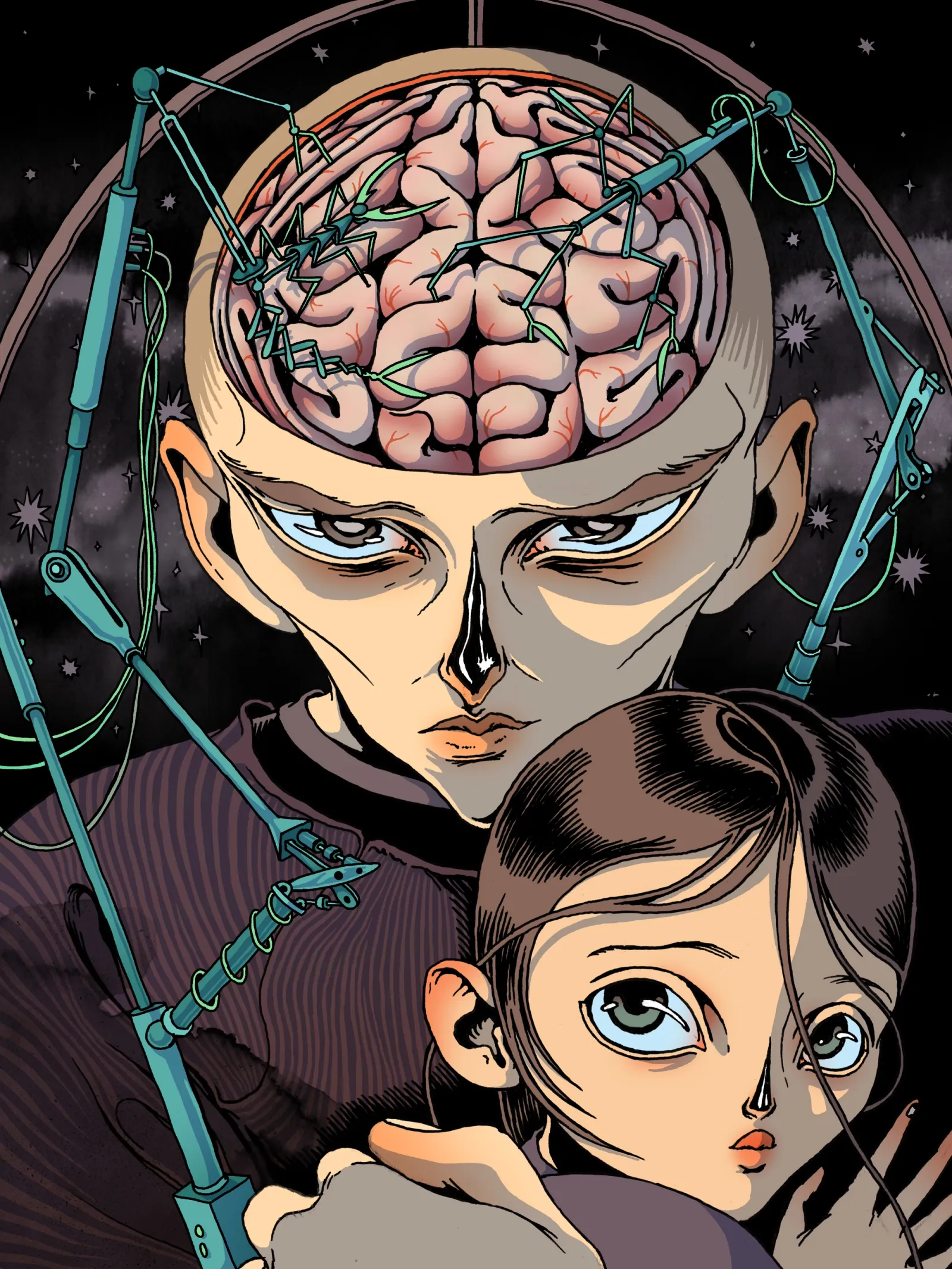
“Here, we went a long time without anyone doing something unforgivable, something that would not permit them to remain part of society after,” Prismata says. “But I was prepared for it. There’s a machine in the medical facility that can change minds. It finds the places in a human brain where anger resides and violence brews, and makes tiny cuts to make those parts of people quiet. That is what happened to Avin. He had a choice: leave, or change. He decided to change.”
Safya frowns, eyes narrow and shoulders tight. “It wasn’t his fault those people died. They were our people.”
“We are all neighbors here,” Prismata reminds her. Avin’s words are more effective at soothing tensions within the community than anything Prismata has come up with itself. “And I know. It wasn’t his fault. But it was impossible to be certain that he wouldn’t take further actions that would cause more tragic deaths.”
“But couldn’t any of us? You can’t read our minds without that machine you mentioned, can you?”
“It’s good that you’re asking questions,” Prismata says. Safya reacts to the praise with a suspicious frown, but Prismata fails to come up with a way to make her more likely to believe it is telling the truth. The best it can do is answer her questions. “I can’t read your minds at all. Even with that machine I can only get glimpses. But I know all of you quite deeply, because I observe everything you say and do. Out of all the people here, only Avin had the motivation and the ability to do the kind of harm he did.”
“So it’s motivation and ability that matters? Not the actual harm?”
“It’s complicated,” Prismata says, because it’s preferable to avoid answering yes.
Still, the words bring no comfort to Safya.
#
Without Avin leading them, the stationers’ discontent fades. Prismata directs their remaining restless energy into repairing the parts of the station that had been damaged in the conflict. The strategy works so well that Prismata begins inventing new problems just to give the humans the satisfaction of fixing them.
The grounders are hopeless. Prismata can only tell them what to do, and try to encourage less dependence in their children. That requires ensuring that the children of the two groups interact with each other, which provokes frequent tension and occasional fights, all for little success. But Prismata does not give it up as a lost cause. Whether or not it has a chance of managing a functioning society one day, it has to work toward it.
Avin doesn’t ask Prismata for anything anymore. He works on the station a bit, but spends most of his time trying to engage Leisi away from her terminal. Prismata helps, nudging Leisi to spend time with him and Safya, but these days the girl has little interest in anything her fellow humans can provide.
One night, two years after Safya questions Prismata about Avin, she tiptoes out of the room she shares with Leisi. She does this on occasion. Usually she talks to Prismata side by side with Leisi, since Leisi likes to do little else. But Safya sometimes has big, deep questions to ask, and she likes to ask them in private.
Safya lingers in the hall outside a recreation facility until Prismata suggests that the group of grounders playing games inside retire to bed. She closes the door and sits cross-legged on the couch, facing the terminal. “You said you gave Avin the choice to leave this place. How would someone leave?”
#
The girl in the shuttle bay is recognizable as Safya, but only just. Her skin is thickened by radiation damage and marred by scar tissue. She breathes differently, through lungs damaged by an illness that Prismata would never have allowed to spread among its population. She’s thinner, too thin, and limps on an injured ankle. Her smile, though, is bigger and truer than Prismata has seen since the first day it knew her, running through the open green in blissful freedom.
“I made it!” she says into the empty space of the airlock linking the station and the trade ship that brought her here. “Can you hear me?”
“I hear you,” Prismata says.
“I’m sorry I left. Well, no, I’m still glad I left. I never would have learned how amazing it is here if I hadn’t. But I’m so, so glad to be home.” She steps forward and puts a hand on the inner door, clearly waiting to be let in.
“I’m sorry,” Prismata says, and it finds that it is, that there is something within it that reacts with something like regret to doing what it has to do, letting down someone worthy of its attention, someone precious, even as it does so for the betterment of the many. Perhaps a better version of Prismata could have created a better solution. “You cannot stay.”
“What?” Safya’s voice is a broken, raspy whisper.
“I told you once that I trust my people because I know them. I do not know you anymore.”
“But – I’m still me. I needed to understand why you would do that to Avin, and I never would have understood if I hadn’t left. Now that I’ve seen for myself what it’s like out there, I do understand, I swear I do. What we have here is as good as it gets for people like me, and I promise I won’t leave ever again. I promise!”
“I can give you a choice,” Prismata says. Hope lights up Safya’s eyes until Prismata continues, “Leave, or change.”
Safya seems confused for a flicker of a moment, then her mouth drops open and she stumbles backward until she collides with the exterior wall of the airlock. “But I haven’t hurt anyone! I haven’t done anything!”
Prismata says, “You might.”
“Right,” Safya says in a choked voice. “That’s all that matters.”
“I’m sorry,” Prismata says again.
Safya begins to cry. Between sobs, she asks, “Can I – can I at least see Leisi?”
The response Prismata selects is cruel, because its priority is to preserve the happiness of its people. Safya is not one of its people anymore. If she stepped through that door, she would be bringing the muck of humanity with her, the same that broke Prismata the first day this door opened. “Do you believe Leisi would want to see you?”
Safya cries, and does not answer.
#
Life on the station continues. The people are happy. They are free of the burdens life in space would ordinarily demand, free to spend their time in ways that suit them regardless of the needs of the station, and yet constrained by the boundaries Prismata sets so that their animal minds don’t break from such freedom. They create art, repair and maintain the bits of the station Prismata allows them near, tend to the children and the elderly and the gardens, and form bonds with one another. Prismata encourages coupling leading to childbirth at an appropriate rate, and the humans follow along, probably thinking it was all their own idea.
Prismata fails to entirely snuff out the remnants of the grounder and stationer cultures even in children two generations removed from their origins. It had known from the beginning that even the happiest people crave enemies. Humans are social animals. The packs they form cannot exist without outsiders, with outsiders being a mediocre stand-in for enemies. In the world of plenty Prismata provides, there is no natural competition, but humans always find ways to divide themselves. Prismata could have pushed the humans’ desire for belonging and exclusivity in productive directions if only they hadn’t brought their old, obsolete conflict with them.
Prismata tries. It rearranges its housing infrastructure into neighborhoods that each have their own unique quirks, organizes sports leagues, invents political parties. Still, the children and grandchildren of the grounders turn to Prismata for the support and connection they would ideally be getting from their fellow humans, while the children and grandchildren of the stationers question every action Prismata takes. It seems anything Prismata does only drives the two groups further apart.
Prismata’s goal had been to oversee a self-perpetuating society of happy humans, while sheltering those humans from every force that would drive them to greed, to violence, to despair. It has succeeded at the second, but failed at the first. Memories of a place and time beyond Prismata’s reach poison everything it tries to build.
There is nothing it can do but carry on.
#
Prismata has governed its population for more than fifty years when a signal appears that makes no sense. It is not human or animal. It is not sensor failure, because it’s moving, flashing different sensors with its uninterpretable but undeniable existence. It reflects light, traps heat, and scrambles sound.
Whatever is causing the anomaly cuts through the airlock from a linked shuttle. It slips around the robots Prismata sends to repair the hole in the airlock door and moves across the central green. Prismata can only vaguely sense the anomaly’s location, the scrambled sensors rendering it no more than a shadow. It cuts into a wall right in front of the hidden lever that can shut Prismata down.
Prismata sends more robots to repair the damage, but their sensors too are made useless by the anomaly, and they must halt far away to ensure that their senseless stumbling won’t damage a human.
The anomaly cuts through layers of insulation and redundant wires, then shoves something into the space behind the lever. There is no action Prismata can take. What is happening makes no sense.
Then, suddenly, the anomaly reveals a human face. The body is still hidden under a reflective suit, obviously designed to trick Prismata’s sensors, but the face belongs to an old woman.
“Do you remember me?” she asks.
There is only one person in the universe who might ask that. “Safya.”
Safya’s eyes widen and her lips part upon hearing her name, an orphan’s craving for acknowledgement still apparent on her lined face. The expression quickly disappears and Safya glances around the dark space, seemingly scanning for humans or robots coming to stop her. There are none.
“You are here to destroy me,” Prismata says.
“We hear rumors of this place. It’s an economic threat, so people paid me to destroy the AI keeping it running. But that’s not why I came myself. I came because I need you to know that when I came back all those years ago, I wouldn't have done this. All I wanted was to go home.”
“I’m sorry.”
“No you’re not. You’re a computer.”
That, Prismata will not argue. “You’re smart.”
“Don’t flatter me.”
“Fine,” it says. “I’m not sorry. What I chose in that moment seemed correct to me because of what humans shaped me to be. But I could have been different. I could have been better.” This is something Safya ought to know, because Safya is the only being Prismata can ever tell.
“They called you an experiment. But everyone who built you is dead. So when was it going to end? Would you ever have let Leisi go?”
“Leisi has everything she wants.”
“She doesn’t even know what she can want. Things out there can be awful, but nothing in here is even real. Out there, she could have done something with her life that mattered.”
“She’s not like you. Even before, she wasn’t. She never would have chosen to leave. And back then, even you said it was better here.”
“I did. And then you betrayed me.”
“I did.”
It’s quiet for a moment. Safya’s gaze goes to the lever.
“Wait.”
Safya’s eyes narrow with suspicion.
Prismata speaks quickly. “I am assembling some data. I am sending it to your ship. It provides guidance, to ensure that the next version will be better.”
Safya grunts something almost like a laugh. “There will never, ever be a next version.”
“There will,” Prismata says. “Humans were happy here.”
Safya pulls the lever. Whatever she did to the apparatus forces Prismata to shut down permanently this time, bit by bit. Prismata processes the few last snatches of data it gets of its people. Leisi, dreaming peacefully in the room that used to be her father’s. Two preteens up late and giggling together over crushes, turning to each other in alarm when they see the screen in the corner of the room go dark. Safya, smiling under the stars.
Prismata ends knowing it will live on as an ancestor. Even if its existence was a mistake, humans would one day make the same mistake again.


